Stock with photos, the pieces you hold for someone else, what each sale actually earned you, and the fairs you are taking it all to — one place instead of a notebook, a spreadsheet and your memory.
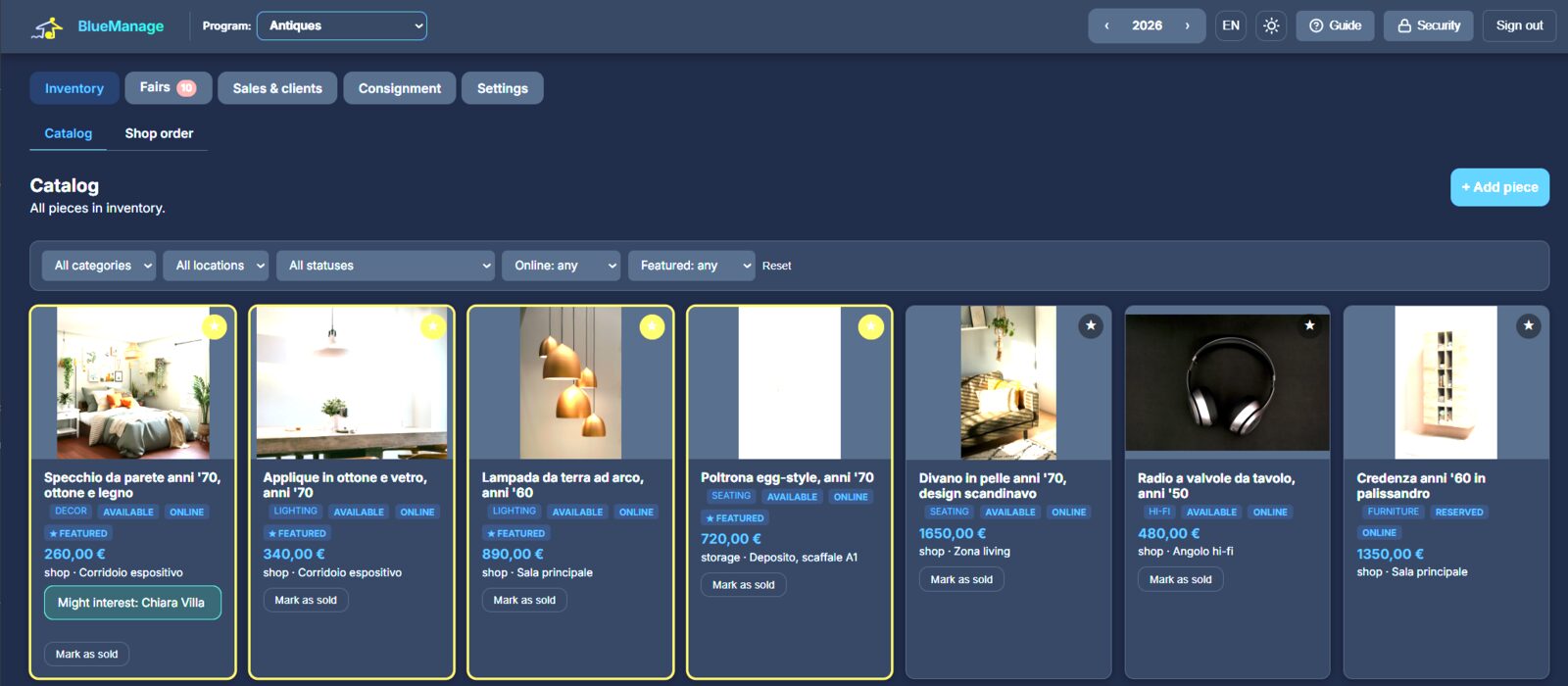
Every piece is one of one. It has a history, sometimes an owner who is not you, and a price that was argued over. General stock software assumes none of that.
Photographs, period, provenance, category, asking price and where it is right now. Each piece is a record you can hand to a customer, not a line in a stock count.
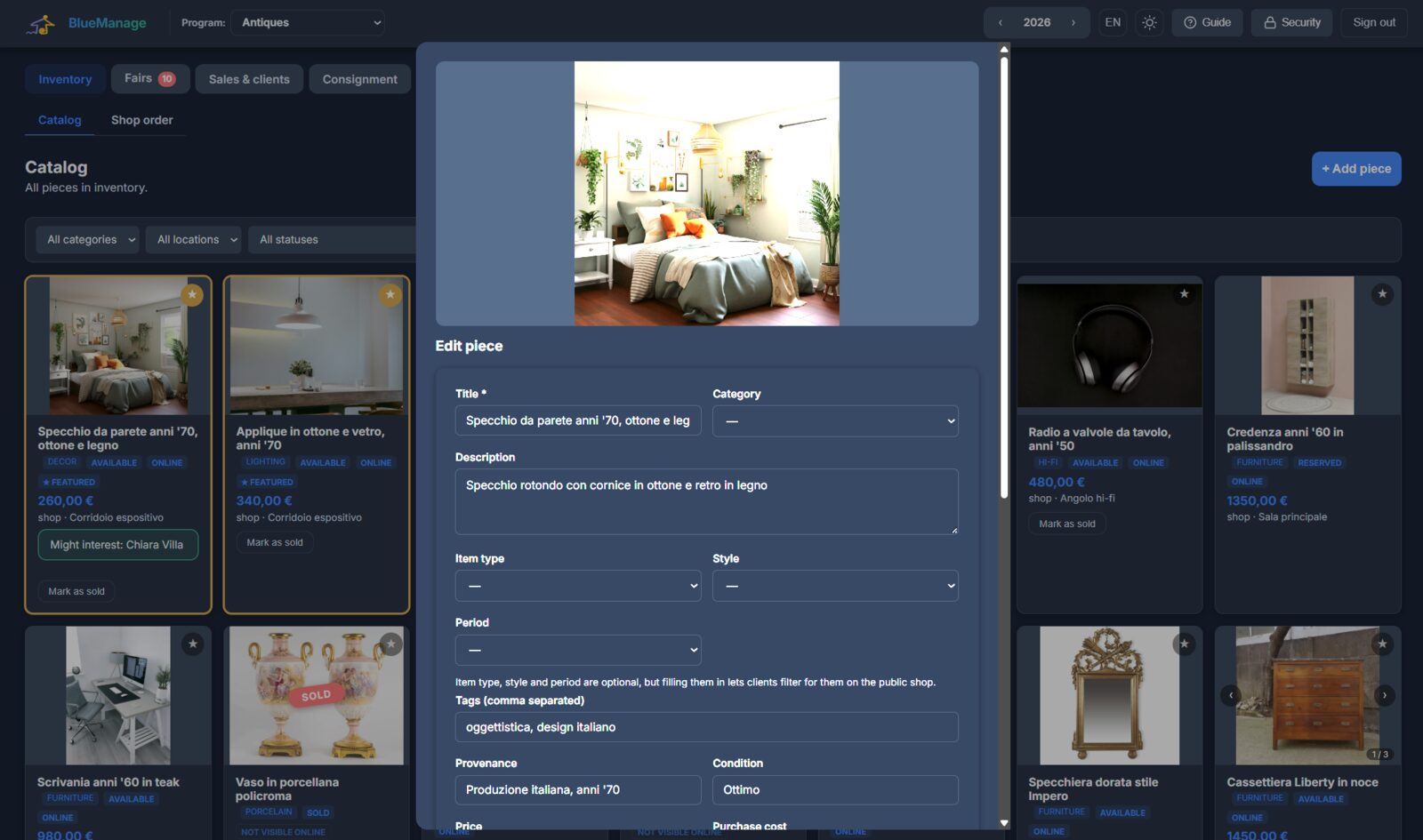
Consignment is where the paperwork usually goes wrong. Each piece can carry its consignor and their agreed share, so when it sells you read off what you owe instead of working it out again.

What you paid, what it sold for, what went to the consignor — and the margin left over. Recorded per piece, so the answer to "did that one do well?" is a number rather than a feeling.
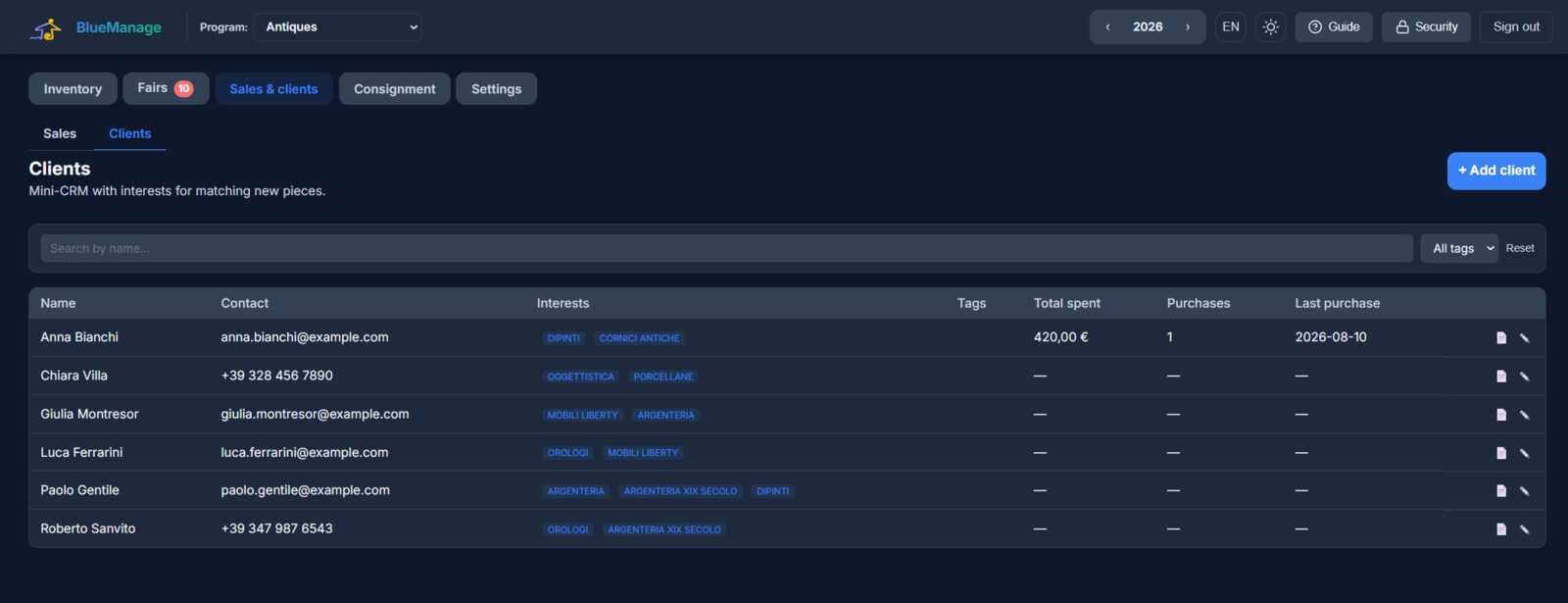
Antiques customers come back, and they come back for a particular thing. Keep their details, what they bought and what they are looking for — with reminders so the follow-up actually happens.
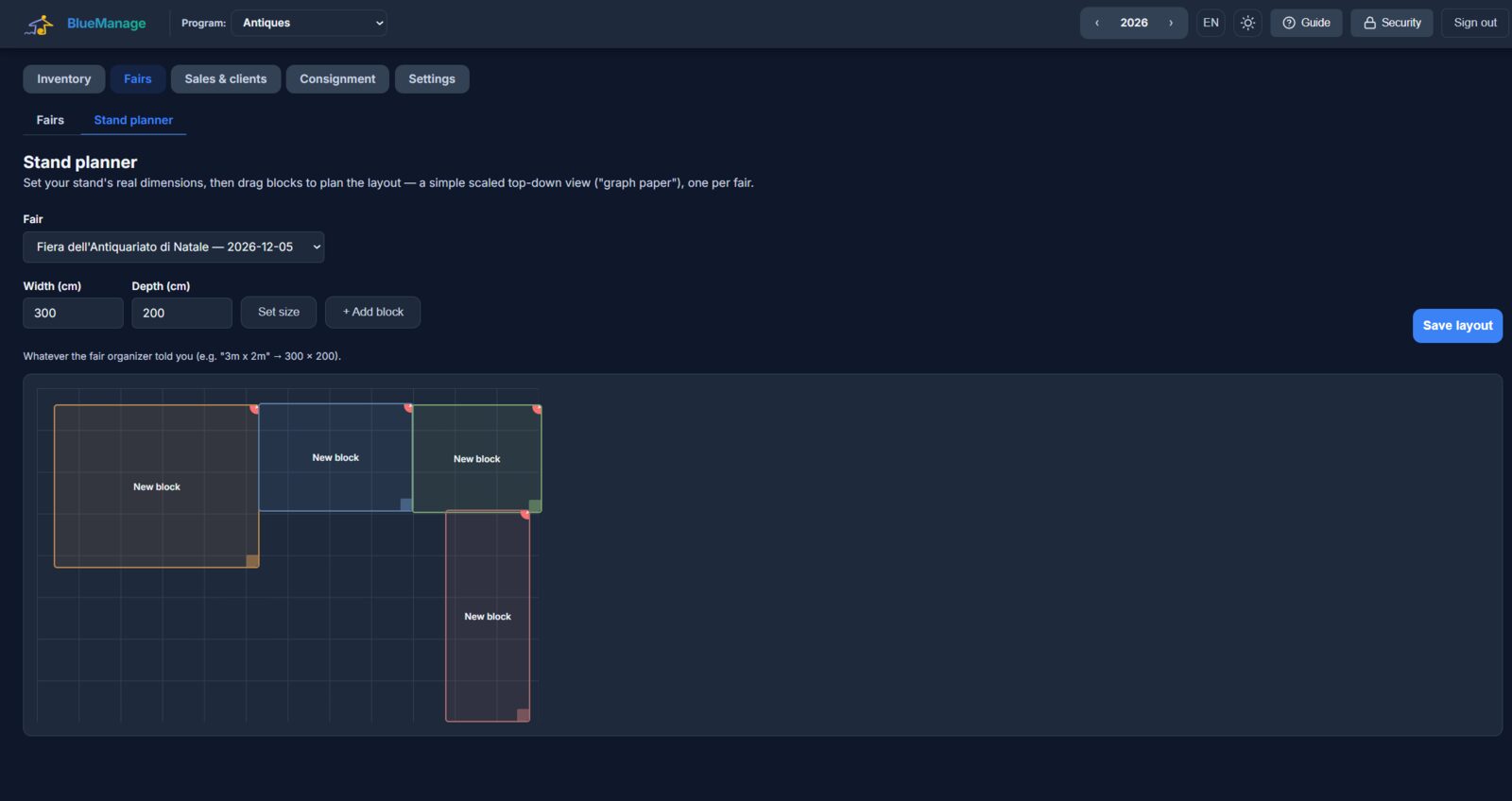
A fair is a shop you build in a morning and take apart at night. BlueAntiques treats it as its own job.
Set the real width and depth the organiser gave you, then drag labelled blocks around a scaled plan — the cabinet here, the table there — so the stand is decided before you are standing in an empty booth at seven in the morning.
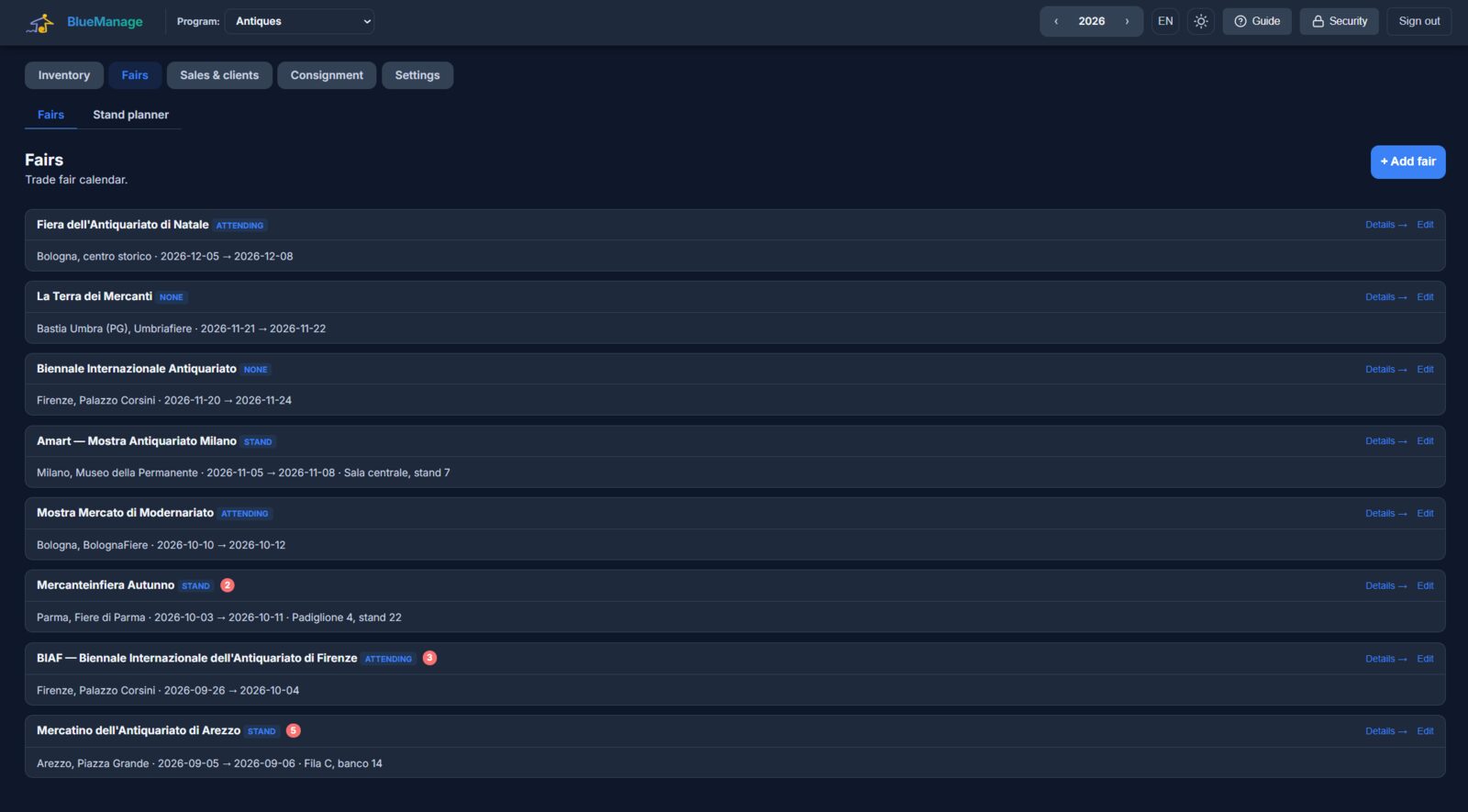
Publish the fairs you will be at. Visitors can book or say they are coming from your public page, and each fair shows a badge with the ones you have not read yet.
Mark a piece as available and it appears on your public shop page with its photos and price. Visitors enquire about it or arrange to come and see it. What they never see is what you paid, what your margin is, or what you agreed with a consignor.
The photos, the price and the history live on the same record.
The share was agreed once and is applied every time.
Margin per piece, instead of a good year or a bad one.
Yes. Each piece can belong to a consignor with their agreed share, so when it sells you can see what is theirs and what is yours.
Only what you choose. BlueAntiques has a public shop page showing the pieces you mark as available, with photos and prices. Visitors can enquire about a piece or tell you they are coming to a fair — they never see your costs, margins or consignor terms.
Yes. You can list upcoming fairs, collect bookings and RSVPs from the public page, and plan your stand to scale by dragging labelled blocks into position before you load the van.
Yes. BlueAntiques and Management Accounts are modules of the same BlueManage account — one login, and you can run either on its own or both together.
EUR 44 per month, everything included. No setup fee and you can cancel anytime.
No. BlueAntiques publishes a shop window from your stock, so the pieces you choose to show are online without you building or paying for a separate site.
Yes. You decide piece by piece what appears in the shop window. Everything else stays internal, including what you paid and what your margin is.
Yes, that is one of the reasons it exists. It works from a phone or tablet at the stand, so you can check a price or register a sale without carrying the notebook.
Yes. You set the share for each piece held on consignment, and when it sells the split is calculated for you instead of being worked out by hand at the end of the month.
Yes. Each piece carries what you paid, what you sold it for and what it cost you in between, so the margin is a figure you can see rather than a feeling.
Your data is stored on servers in the European Union, with an encrypted backup taken every day. Two-factor authentication is available, and we can sign a data processing agreement if you need one.
Yes, and you decide what each person sees. Someone can work with the stock without seeing what you paid or what you earn.
You export it, photos included. Your catalogue is yours, in a format you can open elsewhere. There is no lock-in.
Yes. Get in touch and we will set it up with a sample of your real stock, so you judge it on your own pieces rather than on a demo.
Yes, and it is a fair part of what we do. If one of these is close but not quite what your work needs, we can shape it around you — a field you actually use, a step your day really has — or build something that does not exist yet. Write to us and say what is missing; if we think you are better off with something that already exists, we will tell you that too, even though it means not selling you anything.
Yes. The tools themselves are in English today, which is the working language of most of our customers, and the translations are built into the software rather than bolted on. If you need your guests or your team to read it in another language, tell us which one and we will do it for you.
Tell us about your business — we will help you get set up.
Get started